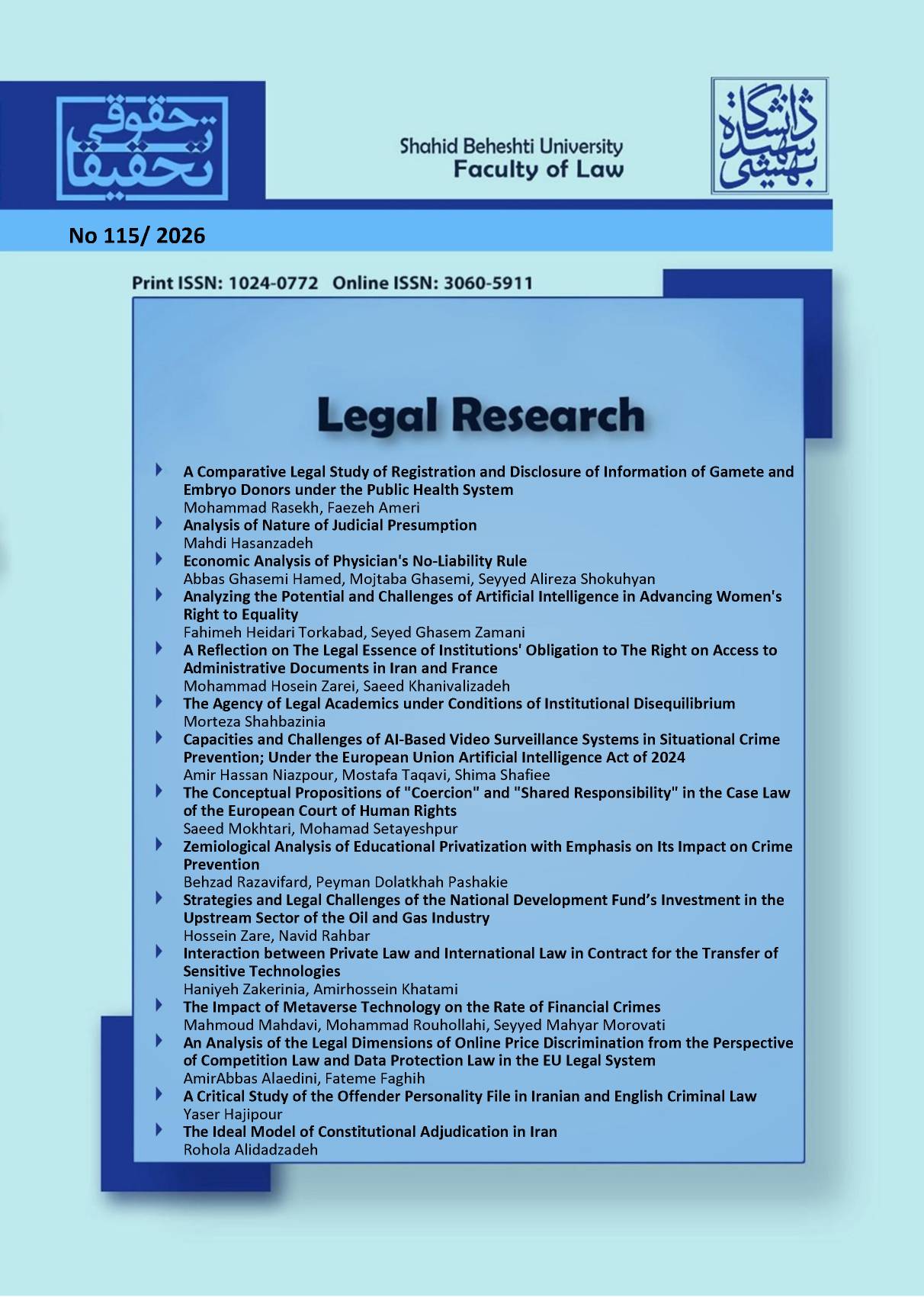
Document Type : Original Article
Highlights
Highlights
· AI-based video surveillance systems can strengthen the capacity of situational crime prevention by enabling early intervention.
· The preventive use of these systems requires adherence to the rule of law, proportionality, fundamental rights and freedoms, privacy, transparency, accountability, and human oversight.
· The European Union Artificial Intelligence Act of 2024 imposes stringent restrictions on certain applications of AI-based video surveillance systems, while several other capabilities remain in need of supplementary rules and safeguards.
References
Books
1. Ansari, Bagher, Data Rights and Artificial Intelligence: Concepts and Challenges, Tehran: Sahami Enteshar Company, First Edition, 2021. (In Persian)
Articles
5. Akpulat, M., and M. Ekinci, "Anomaly Detection in Crowd Scenes via Cross Trajectories", Applied Intelligence, Vol 55, Issue 525, 2025, pp.1-16. https://doi.org/10.1007/s10489-025-06338-z /
6. Ali, M. M., "Real-Time Video Anomaly Detection for Smart Surveillance", IET Image Processing, Vol 17, Issue 5, 2023, pp.1375-1388.https://doi.org/10.1049/ipr2.12720/
7. Chen, K., X. Yang, C. Fan, W. Zhang, and Y. Ding, "Semantic-Rich Facial Emotional Expression Recognition", IEEE Transactions on Affective Computing, Vol 13, Issue 4, 2022, pp.1906-1916. https://doi.org/10.1109/TAFFC.2022.3201290/
8. Choung, H., P. David, and T-W. Ling. "Acceptance of AI-Powered Facial Recognition Technology in Surveillance Scenarios:Role of Trust, Security, and Privacy Perceptions", Technology in Society, Vol 79, 2024, pp.1-11.https://doi.org/10.1016/j.techsoc.2024.102721/
9. Clarke, R. V., "Situational Crime Prevention: Its Theoretical Basis and Practical Scope", Crime and Justice: A Review of Research, University of Chicago Press, Vol 4, 1983, pp.225–256. https://doi.org/10.1086/449090
10. Ebers, M., V. R. S. Hoch, F. Rosenkranz, H. Ruschemeier, and B. Steinrötter. "The European Commission’s Proposal for an Artificial Intelligence Act—A Critical Assessment by Members of the Robotics and AI Law Society(RAILS)", J — Multidisciplinary Scientific Journal, Vol 4, Issue 4, 2021, pp.589-603. https://doi.org/10.3390/j4040043/
11. Esfahani, Babak and Saber Niavarani, “The Principle of Proportionality; A Tool to Guarantee and Balance the Fundamental Rights and Freedoms and Public Interests”, Legal Research Quarterly, Volume 27, Issue 4, 2024, pp.207-224. (In Persian) https://doi.org/10.48308/jlr.2022.220751.1852/
12. Feng, W., F. Wang, R. Han, Y. Gan, Z. Qian, J. Hou, and S. Wang, "Unveiling the Power of Self-Supervision for Multi-View Multi-Human Association and Tracking", IEEE Transactions on Pattern Analysis and Machine Intelligence, Vol 47, Issue 1, 2025, pp.351-368. https://doi.org/10.1109/TPAMI.2024.3463966/
13. Feretzakis, G., K. Papaspyridis, A. Gkoulalas-Divanis, and V. S. Verykios, "Privacy-Preserving Techniques in Generative AI and Large Language Models: A Narrative Review", Information, Vol 15, Issue 11, 2024, pp.1-25. https://doi.org/10.3390/info15110697/
14. Fontes, C., E. Hohma, C. C. Corrigan, and C. Lütge, "AI-Powered Public Surveillance Systems: Why We (Might) Need Them and How We Want Them", Technology in Society, Vol 71, 2022, pp.1-12. https://doi.org/10.1016/j.techsoc.2022.102137 /
15. Ghanad, Fatemeh and Elham Sharif, “Comprehensive Study of Personal Data Protection in Iran's Legal System and European General Data Protection Regulations”, Modern Technologies Law Quarterly, Volumw 2, Issue 4, 2021, pp.1-22. (In Persian) https://doi.org/10.22133/clj.2021.244608.1020/
16. Guan, Z., Z. Wang, G. Zhang, L. Li, M. Zhang, Z. Shi, and N. Jiang. "Multi-Object Tracking Review: Retrospective and Emerging Trend", Artificial Intelligence Review, Vol 58, Issue 235, 2025, pp.1-46. https://doi.org/10.1007/s10462-025-11212-y/
17. Haley, P. "The Impact of Biometric Surveillance on Reducing Violent Crime: Strategies for Apprehending Criminals While Protecting the Innocent", Sensors, Vol 25, Issue 10, 2025, pp.1-21. https://doi.org/10.3390/s25103160 /
18. Huang, J., L. Li, L. Qing, W. Tang, P. Wang, L. Guo, and Y. Peng. "Spatio-Temporal Interactive Reasoning Model for Multi-Group Activity Recognition", Pattern Recognition, Vol 159, 2025, pp.1-14. https://doi.org/10.1016/j.patcog.2024.111104/
19. Johnson, T. L., N. N. Johnson, V. Topalli, D. McCurdy, and A. Wallace. "Police Facial Recognition Applications and Violent Crime Control in U.S. Cities", Cities, Vol 155, 2024, pp.1-14. https://doi.org/10.1016/j.cities.2024.105472 /
20. Matei, A-D., E. Talavera, and M. Aghae."Crime Scene Classification from Skeletal Trajectory Analysis in Surveillance Settings", Engineering Applications of Artificial Intelligence, Vol 141, 2025, pp.1-14. https://doi.org/10.1016/j.engappai.2024.109800
21. Podoletz, L. "We Have to Talk about Emotional AI and Crime", AI & Society, Vol 38, Issue 3, 2023, pp.1067–1082. https://doi.org/10.1007/s00146-022-01435-w/
22. Rezaee, Kh, S. Rezakhani, M. R. Khosravi, and M. K. Moghimi. "A Survey on Deep Learning-Based Real-Time Crowd Anomaly Detection for Secure Distributed Video Surveillance", Personal and Ubiquitous Computing, Vol 28, Issue 1, 2024, pp.135–151.https://doi.org/10.1007/s00779-021-01586-5/
23. Serna, I., A. Morales, J. Fierrez, and N. Obradovich. "Sensitive Loss: Improving Accuracy and Fairness of Face Representations with Discrimination-aware Deep Learning", Artificial Intelligence, Vol 305, 2022, pp.1-15.https://doi.org/10.1016/j.artint.2022.103682/
24. Simmler, M., and G. Canova. "Facial Recognition Technology in Law Enforcement: Regulating Data Analysis of Another Kind", Computer Law & Security Review, Vol 56, 2025, pp.1-10. https://doi.org/10.1016/j.clsr.2024.106092/
25. Talaei Khoei, T., and A. Singh. "A Survey of Emotional Artificial Intelligence and Crimes: Detection, Prediction, Challenges and Future Direction", Journal of Computational Social Science, Vol 7, 2024, pp.2359–2402. https://doi.org/10.1007/s42001-024-00313-3/
26. Veltmeijer, E., and C. Gerritsen. "Legal and Ethical Implications of AI-based Crowd Analysis: The AI Act and Beyond", AI Ethics, Vol 5, Issue 3, 2025, pp.3173–3183. https://doi.org/10.1007/s43681-024-00644-x/
27. Welsh, B. C., and D. P. Farrington. "Surveillance for Crime Prevention in Public Space: Results and Policy Choices in Britain and America", Criminology and Public Policy, Vol 3, Issue 3, 2004, pp.497–526. https://doi.org/10.1111/j.1745-9133.2004.tb00054.x/
28. Zaidenberg, S., B. Boulay, and F. Brémond. "A Generic Framework for Video Understanding Applied to Group Behavior Recognition", IEEE Ninth International Conference on Advanced Video and Signal-Based Surveillance, 2012, pp.1-7. https://doi.org/10.1109/AVSS.2012.1/
29. Zhou, L., and J. Xu. "Enhanced Abandoned Object Detection through Adaptive Dual-Background Modeling and SAO-YOLO Integration", Sensors, Vol 24, Issue 20, 2024, pp.1-20. https://doi.org/10.3390/s24206572
Reports
30. Ratcliffe, Jerry, "Video Surveillance of Public Places (Problem-Oriented Guides for Police. Response Guide Series. Guide No. 4)", U.S.Department of Justice Office of Community Oriented Policing Services, Washington, DC: Center for Problem-Oriented Policing, 2006. https://popcenter.asu.edu/sites/g/files/litvpz3631/files/video_surveillance.pdf
31. The IEEE Global Initiative on Ethics of Autonomous and Intelligent Systems. Ethically Aligned Design: A Vision for Prioritizing Human Well-being with Autonomous and Intelligent Systems, First Edition. IEEE, 2019.https://standards.ieee.org/content/ieee-standards/en/industry-connections/ec/autonomous-systems.html/
Website
32. "CCTV Camera Market Size, Global Report 2022-2029", Fortune Business Insights, 2025, Accessed 02 December 2025. https://www.fortunebusinessinsights.com/cctv-camera-market-107115/