Legal Research Quarterly

Legal Research Quarterly

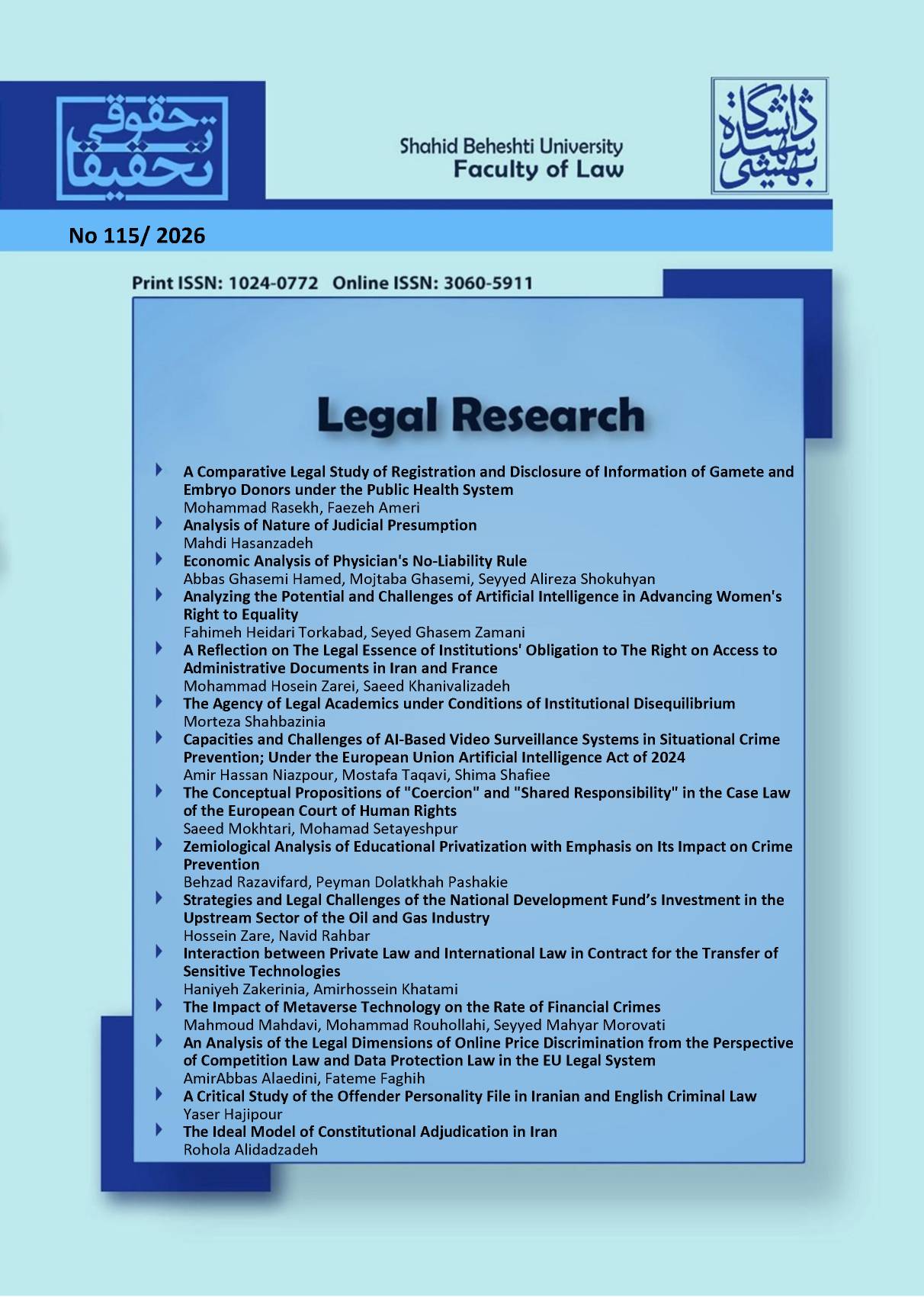
An Analysis of the Legal Dimensions of Online Price Discrimination from the Perspective of Competition Law and Data Protection Law in the EU Legal System

Document Type : Original Article

Authors
1 Assistant Professor, Institute of Culture & Communication, Allameh Tabataba’i University, Tehran, Iran Corresponding Author Email: amirabbas.alaedini@atu.ac.irIran.
2 , MA. Student in International Trade Law, Faculty of Law and Political Science, Allameh Tabataba’i Univerity, Tehran, Iran.
10.48308/jlr.2026.242825.3016
Abstract
Abstract
Introduction
The development of digital markets and the growing use of personal data and advanced algorithms have significantly transformed traditional pricing practices. In digital markets, firms can use behavioral data and other information about users to identify their characteristics, preferences, and price sensitivity, and consequently offer different prices to different consumers. This practice, commonly referred to as personalized or algorithmic price discrimination, provides firms with a greater capacity to differentiate among consumers than traditional forms of price discrimination and, in some cases, may enable them to set individualized prices for consumers. The expansion of this practice, alongside its economic and welfare effects, has raised questions concerning the scope of competition law and the requirements of personal data protection. The importance of this issue lies partly in the fact that personalized price discrimination does not produce the same effects in all markets. Under certain conditions, offering prices according to consumer characteristics may increase competition, create greater price variety, and potentially improve consumer welfare. In contrast, in concentrated or monopolistic markets, extensive access to personal data may enable firms to exploit consumers more effectively, strengthen market power, and reduce transparency. At the same time, personalized pricing generally requires the processing of personal data and therefore raises questions under data protection law, particularly concerning the lawfulness of processing, transparency, and user consent. Against this background, this study examines the economic and legal dimensions of personalized price discrimination to determine under what circumstances this pricing practice may raise concerns under competition law and personal data protection law in the European Union.
Methods
This study adopts a descriptive-analytical method and draws on economic and legal studies as well as relevant case studies concerning online markets. It first examines the concept of price discrimination, its principal forms, and the conditions required for its implementation. It then focuses on the specific characteristics of algorithmic personalized price discrimination, including the role of personal data, algorithms, and the ability of firms to differentiate among consumers. Subsequently, the study examines the effects of price discrimination under different market structures, with particular attention to competition, consumer welfare, market power, and distributive considerations. The practice is then analyzed within the framework of European Union competition law, including its potential relationship with the rules concerning abuse of a dominant position and other competition concerns. The study also considers personalized price discrimination from the perspective of personal data protection law, focusing on the requirements governing data processing, consent, and transparency. Finally, the economic and legal findings are combined to examine the possibility of adopting a multidimensional approach to the assessment and regulation of this practice.
Results and Discussions
The findings indicate that the effects of algorithmic price discrimination cannot be assessed independently of market structure and firms’ access to consumer data. In relatively competitive markets, personalized pricing can enable firms to offer a wider range of prices and, under certain conditions, may contribute to increased competition and consumer welfare. The same mechanism may nevertheless produce different consequences in concentrated or monopolistic markets. Greater access by dominant firms to consumers’ behavioral data can enable them to estimate consumers’ willingness to pay more accurately and extract a greater portion of consumer surplus. Consequently, the risks of consumer exploitation and strengthened market power may increase. From the perspective of European Union competition law, one of the main challenges is that personalized price discrimination, unlike many traditional forms of discriminatory conduct, is applied directly to final consumers and does not necessarily correspond to established patterns of anticompetitive behavior. Accordingly, the mere fact that different consumers are offered different prices is not, by itself, sufficient to justify competition law intervention. The legal assessment should take into account the structure of the relevant market, the firm’s degree of market power, the nature of the product or service, the intensity of competition, and the actual or potential effects of the conduct on the market. At the same time, where algorithmic price discrimination results in harm to competition, consolidation of a dominant position, or barriers to entry of competitors, it may become relevant under the rules governing abuse of dominance. A case-by-case assessment that takes the particular circumstances of each market into account is therefore important in evaluating this pricing practice. The economic analysis also indicates that price discrimination cannot be regarded as inherently anticompetitive or welfare-enhancing. Its effects depend on the way in which data are used, the structure of the market, and the degree of market power held by the firm. A general prohibition of all forms of personalized pricing may therefore conflict with its potentially beneficial effects in certain markets, while ignoring its risks in concentrated markets may contribute to increased market power and consumer exploitation. From the perspective of personal data protection law, personalized pricing generally involves the collection, processing, and analysis of information concerning users. Such information may include search and purchase histories, users’ behavior on websites, location information, cookies and other online identifiers, and behavioral patterns. Personalized pricing may therefore fall within the scope of personal data protection rules. Under the European Union data protection framework, firms must have a lawful basis for processing personal data and provide users with clear and accessible information concerning the purposes and manner of processing. In cases where consent constitutes the legal basis for processing, informed consent assumes particular importance, since consumers may not agree to the use of their personal data for individualized pricing. The use of cookies and similar technologies may also trigger specific requirements concerning user consent. Transparency requirements may also affect the effectiveness of personalized price discrimination itself. When consumers become aware of personalized pricing and the ways in which their data are used, they may respond by restricting firms’ access to personal data, using anti-tracking tools, deliberately altering their behavioral patterns, or adopting other similar measures. These responses may reduce the ability of algorithms to identify consumers’ characteristics accurately. Data protection therefore concerns not only the lawfulness of information processing but may also indirectly affect the ability of firms to implement personalized pricing models effectively.
Conclusion
Personalized price discrimination is an emerging phenomenon in the digital economy that connects the use of personal data and algorithms with pricing decisions. The findings of this study indicate that its effects depend on market conditions and the manner in which data are accessed and used, and therefore cannot be assessed solely by reference to the concept of price discrimination. From the perspective of competition law, particular attention should be paid to the effects of the practice on competition, market power, and the conditions of entry for competitors. From the perspective of data protection law, the lawfulness of processing, transparency, and informed consent are particularly important. Accordingly, the regulation of algorithmic personalized price discrimination requires a multidimensional approach that considers economic efficiency, competition, consumer welfare, and distributive concerns alongside the protection of personal data.

Highlights


Highlights

·         The effects of algorithmic price discrimination depend on market structure and access to data, and may, depending on the circumstances, produce both pro-competitive and welfare-enhancing effects as well as exploitative effects

·         Under European Union competition law, personalized price discrimination does not yet fully correspond to traditional patterns of abuse of a dominant position; however, where it disrupts competition or reinforces market power, it may become subject to competition law intervention.

·         The use of personal data for personalized pricing requires compliance with data protection requirements, particularly lawfulness, transparency, and informed consent, while regulating this phenomenon requires simultaneous consideration of competition, welfare, distributive justice, and data protection.

Keywords
Subjects

References
Books
1.        Ezrachi, A., & Stucke, M. E., Virtual Competition: The Promise And Perils Of The Algorithm- Driven Economy. 1st Edition, Cambridge, Harvard University Press, 2016.
2.        Motta, M., Competition Policy: Theory And Practice. 1st Edition, Cambridge: Cambridge University Press, 2004.
3.        Niels, Gunnar, Helen Jenkins, And James Kavanagh, Economics For Competition Lawyers. 2nd Ed., United Kingdom: Oxford Univeristy Press, 2016.
4.        Posner, R, Antitrust Law. 2nd Edition, Chicago: University Of Chicago Press, 2001.
5.        Rodger, B. J., And Macculloch, A., Competition Law And Policy In The Ec And Uk, 4th Edition. New York: Routledge, 2008.
6.        Stigler, G. J., Theory Of Price. 4th Edition, New York: Macmillan, 1987.
7.        Turow J., The Daily You: How The New Advertising Industry Is Defining Your Identity And Your Worth. 1st Edition, New Haven: Yale University Press, 2011.   
Articles
8.        Alves de Oliveira, R. & Bollen, M., “Deep Learning for Power Quality,” Electric Power Systems Research, Vol. 214, 2023, pp. 1-12. https://doi.org/10.1016/j.epsr.2022.108887
9.        Bergemann, D., Brooks, B., And Morris, S. “The Limits Of Price Discrimination”, American Economic Review, Vol. 105, Issue 3, 2015, pp. 921-957.  
10.    Borgesius, F. Z., & Poort, J. “Online Price Discrimination And Eu Data Privacy Law”, Journal Of Consumer Policy, Vol. 40, Issue 3, 2017, pp. 1-20. http://Dx.Doi.Org/10.2139/Ssrn.3009188/
11.    Botta, M., Wiedemann, K. “To Discriminate Or Not To Discriminate? Personalized Pricing In Online Markets As Exploitative Abuse Of Dominance”, European Journal Of Law And Economics. Vol. 50, 2020, pp. 381–404. Https://Doi.Org/10.1007/S10657-019-09636-3/
12.    Cavallo, A. “More Amazon Effects: Online Competition And Pricing Behaviors”, Cambridge, Ma: National Bureau Of Economic Research(Nber). Working Paper No. W25138, 2019, pp.1-37. Https://Doi.Org/10.3386/W25138  
13. Competition And Markets Authority [Cma]. “Pricing Algorithms: Economic Working Paper On The Use Of Algorithms To Facilitate Collusion And Personalized Pricing”, Competiton And Markets Authority, 2018. Available At: https://www.gov.uk/government/publications/pricing-algorithms-research-collusion-and-personalised-pricing/ 
14.    D., Brooks, B., And Morris, S. “The Limits Of Price Discrimination”, American Economic Review, Vol. 105, Issue 3, 2015, pp. 921–957. Http://Dx.Doi.Org/10.1257/Aer.20130848
15.    Executive Office Of The President Of The United States (Council Of Economic Advisors). “Big Data And Differential Pricing”, White House Reports, 2015.  Available At:https://obamawhitehouse.archives.gov/sites/default/files/whitehouse_files/docs/Big_Data_Report_Nonembargo_v2.pdf  Accessed On 22 April 2025.
16.    Gautier, A., Ittoo, A., And Van Cleynenbreugel, Pieter. “Ai Algorithms, Price Discrimination And Collusion: A Technological, Economic And Legal Perspective”, European Journal of Economic Law, Vol. 50, 2020, pp. 1-31. https://Doi.Org/10.1007/S10657-020-09662-6/
17.    Geradin, D, & Petit, N. “Price Discrimination Under Ec Competition Law: The Need For A Case-By-Case Approach”, Global Competition Law Centre Working Paper Series, Issue 07/05, 2005. http://Dx.Doi.Org/10.2139/Ssrn.763484/
18.    Ghanad, F., Sharif, E. “A Preliminary Study Of Personal Data Protection In The Iranian Legal System And The Eu General Data Protection Regulation”, Bi-Annual Journal Of New Technology Law, Vol. 2, Issue 4, 1400, pp.1-22. Doi:10.22133/Clj.2021.244608.1020 (In Persian)
19.    Ghose, A., Yang, S. “An Empirical Analysis Of Search Engine Advertising: Sponsored Search In Electronic Markets”, Management Science, Vol. 55, Issue 10, 2009, pp. 1605–1622. https://Doi.Org/10.2139/Ssrn.1022467
20.    Graef, I. “Algorithms And Fairness: What Role For Competition Law In Targeting Price Discrimination Towards End Consumers?”, Columbia Journal Of European Law, Vol. 24, Issue 3, 2018, pp. 541-559. Http://Dx.Doi.Org/10.2139/Ssrn.3090360
21.    Guerrero Perez, A., Ancelin, O., Trapp, D., And Pomana, A. “Competition Authorities Zero In On Antitrust Risks Of Algorithmic Pricing”. Global Competition Review, September 2025. Available At: Https://Globalcompetitionreview.Com/Guide/Digital-Markets-Guide/Fifth-Edition/Article/Eu-Competition-Authorities-Zero-In-Antitrust-Risks-Of-Algorithmic-Pricing/  Last Visited On 3 December 2025.
22.    Hannak, A., Soeller, G., Lazer, D.M., Mislove, A., And Wilson, C. “Measuring Price Discrimination And Steering On E-Commerce Web Sites”, Proceedings Of The 2014 Conference On Internet Measurement Conference, 2014, pp. 305-318. https://doi.org/10.1145/2663716.2663744
23.    Hildebrandt, M., Koops, B. J. “The Challenges Of Ambient Law And Legal Protection In The Profiling Era”, The Modern Law Review, Vol. 73, Issue 3, 2010, pp. 428-460. https://doi.org/10.1111/j.1468-2230.2010.00806.x
24.    Klein, B, “Price Discrimination And Market Power”, Issues In Competition Law And Policy, Vol. 2, 2008, pp. 977-996, Available At: Https://Ssrn.Com/Abstract=1657202
25.    Liu, Q & Serfes, K. “Quality Of Information And Oligopolistic Price Discrimination”, Journal Of Economics & Management Strategy, Vol.13, Issue 4, 2004, pp. 671-702. Https://Doi.Org/10.1111/J.1430-9134.2004.00028.X/  
26. Mcsweeny, T., & O'dea, B. “The Implications Of Algorithmic Pricing For Coordinated Effects Analysis And Price Discrimination Markets In Antitrust Enforcement”, Antitrust, Vol.32, Issue 1, 2017, pp. 75-81. Available At: https://www.ftc.gov/news-events/news/speeches/implications-algorithmic-pricing-coordinated-effects-analysis-price-discrimination-markets-antitrust
27.    Mehra, S. K. “Price Discrimination-Driven Algorithmic Collusion: Platforms For Durable Cartels”, Stanford Journal Of Law, Business, And Finance, Forthcoming, Temple University Legal Studies Research Paper, Issue 35, 2020. Available At: Https://Ssrn.Com/Abstract=3699032/ 
28.    Nouri Youshanlouei, J, Farkhani, H. “Discriminatory Pricing In Comparative Competition Law”, Administrative Law Quarterly, Vol. 1, Issue 2, 2013, pp. 159-220. http://Qjal.Smtc.Ac.Ir/Article-1-33-Fa.Html (In Persian)
29.    Odlyzko, A. “Network Neutrality, Search Neutrality, And The Never-Ending Conflict Between Efficiency And Fairness In Markets”, Review Of Network Economics, Vol.8, Issue 1, 2009, pp.40-60. https://Doi.Org/10.2139/Ssrn.1095350
30.    Office Of Fair Trading, “The Economics Of Online Personalized Pricing”, Office Of Fair Trading, No. Oft1488, 2013.  Archived. Accessed 10 January 2025.
31.    Organization For Economic Co-Operation And Development [OECD], “Algorithmic Competition”, Oecd Roundtables On Competition Policy Papers, 2023.  Https://Doi.Org/10.1787/Cb3b2075-En /
32.    Organization For Economic Cooperation And Development [Oecd], “Price Discrimination”, Oecd Roundtables On Competition Policy Papers, 2016. https://Doi.Org/10.1787/4ee4dc56-En
33.    Rahbari, E. “Algorithmic Price Collusion: A Comparative Study In The Competition Law Of The Usa, Eu, And Iran”, Comparative Law Studies Quarterly, Vol. 14, Issue 1, 2023, pp.269-290. https://Doi.Org/10.22059/Jcl.2023.345558.634394 (In Persian)
34.    Rahbari, E. “An Analysis Of The Challenges Of Competition Law For Big Data”, Quarterly Journal Of Legal Research, Vol.25, Issue 98, 2022, pp. 295-320. https://Doi.Org/10.29252/Jlr.2022.226773.2164 (In Persian)
35. Stole, L. A. “Price Discrimination And Imperfect Competition”, In: Handbook Of Industrial Organizatio, Amsterdam: Elsevier, Vol 3, 2007, pp. 2221-2299. https://doi.org/10.1016/S1573-448X(06)03034-2
36. Strandburg, K. J. “Free Fall: The Online Market's Consumer Preference Disconnect”,  University Of Chicago Legal Forum, 2013, Available At: Available at: https://ssrn.com/abstract=2323961
37.    Townley, C,  Morrison, E. & Yeung, K. “Big Data And Personalized Price Discrimination In Eu Competition Law”, Yearbook Of European Law, Issue 36, 2017, pp. 1-58.  https://Doi.Org/10.1093/Yel/Yex015
38.    Turow J., King, J., Hoofnagle, C. J., Bleakley, A., And Hennessy, M. “Americans Reject Tailored Advertising And Three Activities That Enable It”, SSRN Electronic Journal, September 2009. http://Dx.Doi.Org/10.2139/Ssrn.1478214/
39. Turow, J., Feldman, L., & Meltzer, K. “Open To Exploitation: America’s Shoppers Online And Offline”, A Report From The Annenberg Public Policy Center Of The University Of Pennsylvania, June 2005. https://repository.upenn.edu/handle/20.500.14332/2000
40.    Varian, H. R. “Price Discrimination”. In: Handbook Of Industrial Organization. Amsterdam: Elsevier, Vol.1, 1989. pp.597–654.
41.    Yadav, S. P., “A Research Paper On-Price Discrimination”, International Journal Of Science And Research (Ijsr), Vol.12, Issue 2, 2023, pp. 1388-1393. Https://www.Doi.Org/10.21275/Sr23220191529/  
42.    Zeynoddin, M. “What Is Pricing And Why Is The Survival Of Businesses Dependent On It?”,  Bana: Bi-Monthly Journal Of Business Economics And Management, Vol. 1, Issue 1, October 2023, pp. 16-20. (In Persian)
Thesis
43.    Azizianpour, Kosar.“Legal Rules Governing Profiling”, Master’s Thesis. Tehran: Shahid Beheshti University, 2023. (In Persian)

  • Receive Date 09 December 2025
  • Revise Date 25 January 2026
  • Accept Date 18 April 2026