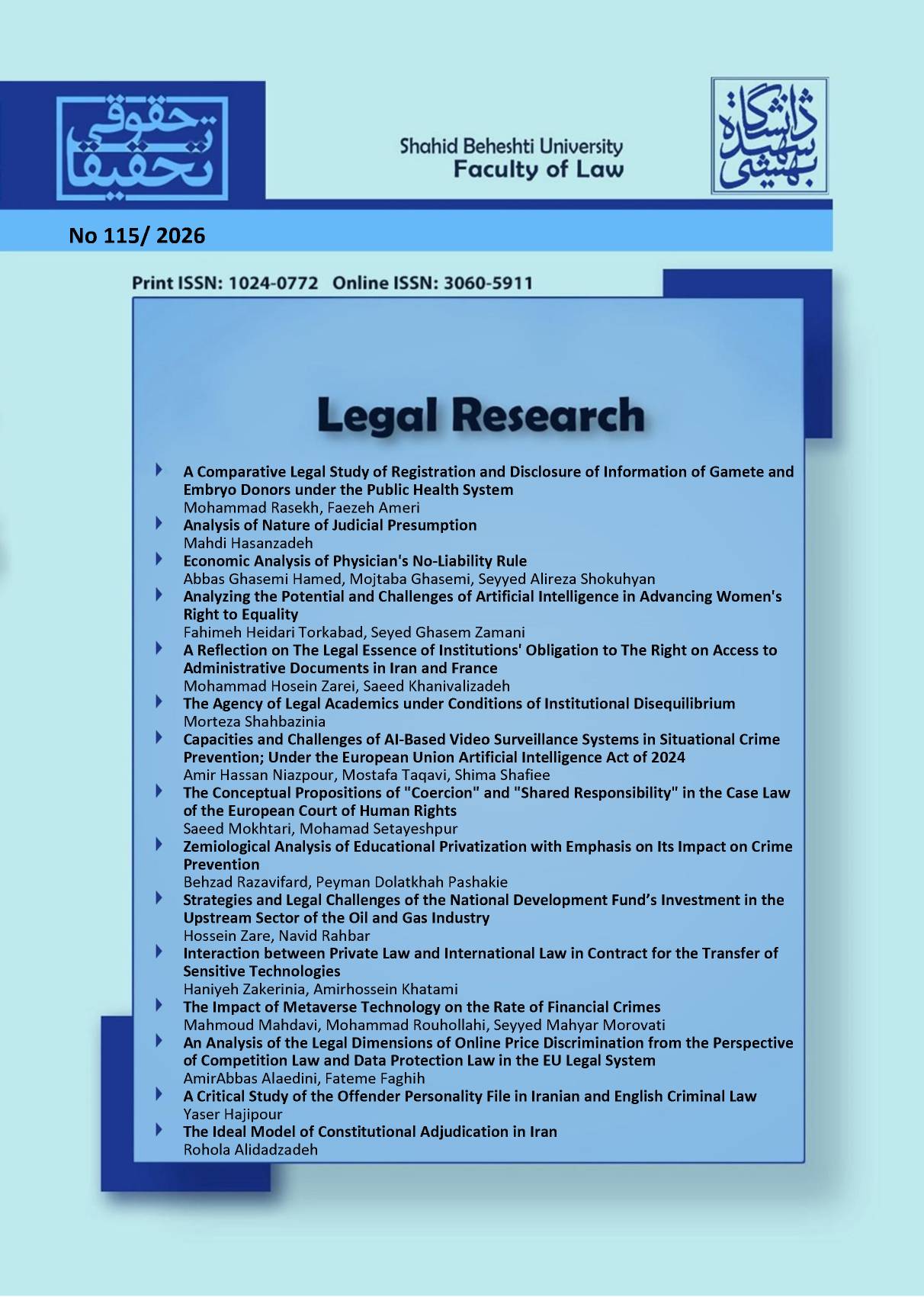
Document Type : Original Article
Authors
1
Associate professor
2
Assistant professor in public law
10.22034/jlr.2020.160907.1289
Abstract
Abstract
Introduction
The Right of Access to Administrative Documents plays a significant role in protecting individual rights, facilitating public participation in decision-making, enabling oversight of administrative authorities, and preventing administrative corruption. Access to information allows citizens to understand how public powers are exercised and how administrative decisions are made. It can also strengthen public trust by reducing the secrecy that traditionally characterized relations between administrative authorities and citizens. Both the Islamic Republic of Iran and France have recognized this right in their legal systems, although secrecy long remained the prevailing approach to administrative information. France took a significant step toward transparency through the Law of 17 July 1978, while Iran adopted the Law on the Publication and Free Access to Information in 2009. The effective exercise of this right depends substantially on identifying the persons and institutions legally obliged to provide access to administrative documents. Even where legislation formally recognizes the right, uncertainty concerning its institutional scope may restrict its practical application. If the relevant criteria are unclear, institutions may rely on their legal status, organizational form, or interpretation of their functions to deny access. This issue becomes particularly important when public responsibilities are performed by private entities or when public information is held outside the conventional administrative structure. Accordingly, this study examines which institutions are bound by the right of access to administrative documents under Iranian and French law, how the applicable criteria have developed, and what shortcomings affect the identification of obligated institutions in each legal system.
Methods
This study adopts a descriptive-analytical, comparative legal method. The French analysis draws on the Law of 17 July 1978, the 2015 Code of Relations between the Public and the Administration, decisions of the Conseil d’État, CADA opinions, and legal scholarship. The Iranian analysis relies on the Law on the Publication and Free Access to Information, its 2014 Executive Regulations, the Civil Service Management Law, the Public Accounting Law, a Judiciary advisory opinion, and doctrinal writings. The French section examines the criteria for identifying administrative documents and institutions subject to access obligations; the Iranian section examines public institutions, private institutions, and private institutions providing public services, focusing on statutory ambiguities.
Results and Discussions
In France, Article L. 300-2 of the Code of Relations between the Public and the Administration identifies the State, local authorities, other public-law persons, and private-law persons entrusted with a public service mission as institutions subject to the right of access. The obligation covers only documents produced or received in performing that mission. Identifying obligated institutions therefore requires examining the nature, origin, possession, and use of relevant documents. French law and administrative jurisprudence recognize three criteria for identifying administrative documents. The first is the criterion of origin, which links a document’s administrative character to its source. The Narcy criteria help identify private entities performing public service missions by considering their public-interest activities, supervision by a public authority, and possession of special powers. However, origin alone is insufficient for documents created by private persons but held by administrative authorities. The second is the criterion of possession, emphasized in CADA’s practice. Mere possession is not conclusive: the Conseil d’État’s decision in the Christian Hudin case demonstrates that accidental possession does not necessarily make a document administrative or subject to disclosure. The third concerns administrative operations performed on documents. Privately created documents may acquire an administrative character when used by an authority in performing its functions. Building-permit applications and accompanying plans illustrate this criterion, provided they have a sufficient connection with the relevant public service mission. Legislative developments have sought to reconcile these criteria. The 2005 reform combined creation and possession, while the 2009 reform emphasized documents produced or received in performing a public service mission, a formulation retained in the 2015 Code. Subsequent jurisprudence clarified that possession by an institution performing public services does not automatically entail disclosure. French law thus combines concise statutory provisions with judicial interpretation defining the limits of access. In Iran, Article 5 of the Law on the Publication and Free Access to Information addresses public institutions, while Article 8 concerns private institutions. The 2014 Executive Regulations distinguish public institutions, private institutions, and private institutions providing public services, yet their boundaries remain uncertain. Unlike French law, neither the Law nor its Executive Regulations adopts the criteria of creating or possessing a document to determine which documents an institution must disclose. Identifying public institutions is relatively straightforward where the law covers state organs, the armed forces, the legislative and judicial branches, institutions under the Supreme Leader, and entities in which the State holds more than fifty percent of the shares. Greater ambiguity concerns non-governmental public institutions. Administrative practice appears to emphasize their express inclusion in statutory lists, raising questions about the relationship with Article 3 of the Civil Service Management Law. An advisory opinion of the Judiciary’s legal department suggests a different interpretation, while Islamic Azad University illustrates the practical uncertainty. These competing interpretations may produce inconsistent decisions on which institutions must comply with access requests. The scope of obligations imposed on private institutions is also unclear. Although the legislation refers broadly to them, the Executive Regulations do not establish whether all private entities are covered or only those providing public services. A broader interpretation is plausible because private entities may hold information of a public and impersonal nature. Excluding them solely because of their private legal status could restrict access to information relevant to public accountability. Private institutions entrusted with public services form a more identifiable category. Professional associations, banks, and the stock exchange illustrate that private legal status does not necessarily exempt entities from disclosure obligations. Their status should be assessed according to their activities and relationship with the public interest, since public functions may be performed outside the formal state administration.
Conclusion
The comparison reveals a decisive difference between the legislative techniques of France and Iran. French law establishes a concise institutional scope and clearly defines its application through the criteria of document creation, receipt, possession, and connection with a public service mission. Decisions of the Conseil d’État have played a crucial role in distinguishing documents that are genuinely administrative from those whose possession by an authority is merely incidental. Iranian law, despite listing several categories of obligated institutions, fails to resolve key questions, particularly concerning non-governmental public institutions and the scope of obligations on private entities. These ambiguities and legal gaps produce arbitrary implementation and let institutions evade disclosure obligations. Effective protection of the right demands that institutions be assessed by their legal characteristics, functions, and relationship with public responsibilities, never by their formal titles alone. Legislative clarification, the adoption of necessary implementing rules, and more consistent interpretation by the Administrative Justice Court and the Commission on Publication and Free Access to Information are therefore indispensable. In particular, the Commission must actively promote uniform practice and resolve interpretive disputes, while judicial review must clearly define the legal boundaries of the obligation. Eliminating unjustified institutional exclusions will strengthen transparency and improve the practical effectiveness of the right of access to administrative documents in Iran.
Highlights
Highlights
- In France, the law uses short, general criteria to bring a wide range of institutions under the right of access. In Iran, despite a long list of covered institutions and ambiguity regarding non-governmental public institutions and the scope of obligations on private institutions, the law’s purpose is not fully achieved, and some institutions can still evade its application.
- In France, the criteria of creating and possessing a document, together with its connection to a public service mission, determine the scope of an institution’s disclosure obligation. Iran’s Law on the Publication and Free Access to Information and its Executive Regulations, however, do not adopt such a criterion.
- Despite its importance for achieving transparency, Iran’s Law on the Publication and Free Access to Information has not achieved its intended objectives due to ambiguities and legal gaps, and in practice it is applied arbitrarily.
Keywords
Subjects