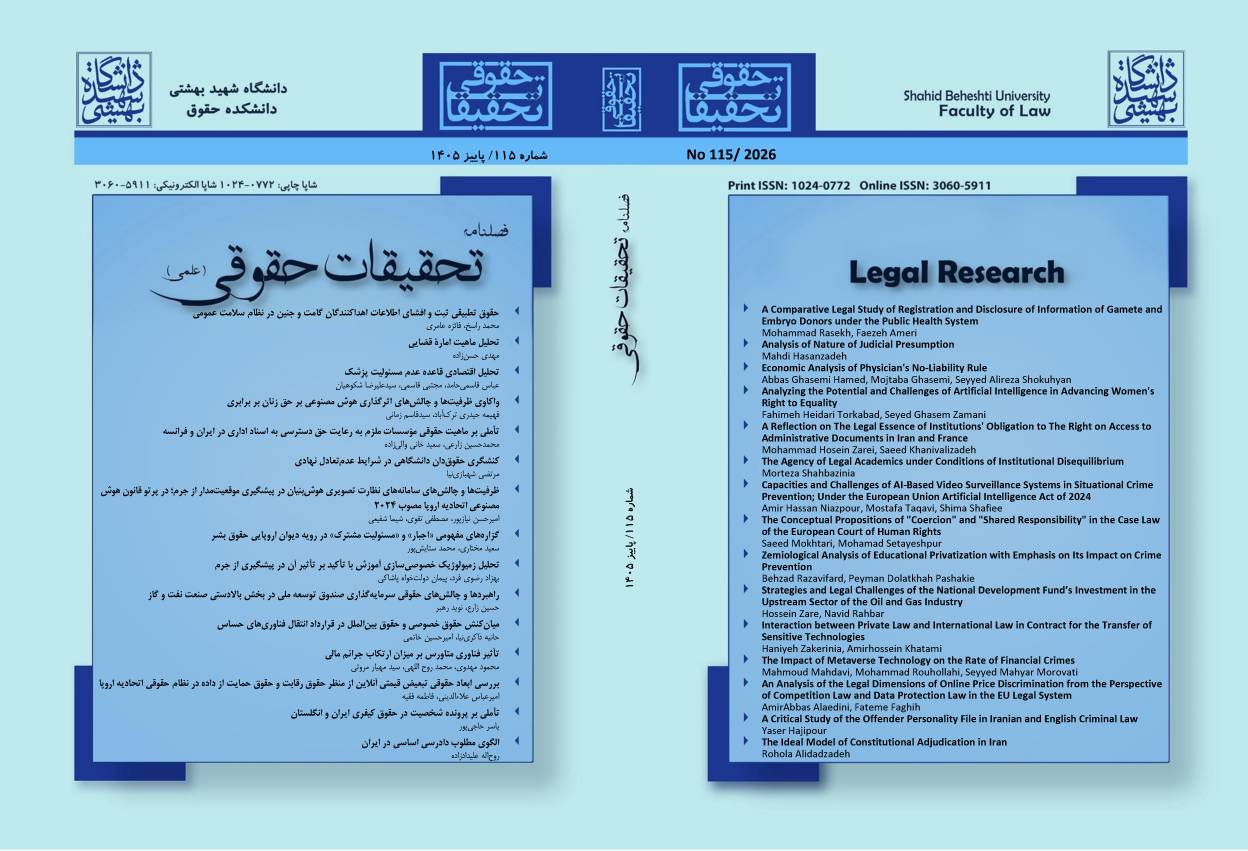
فصلنامه تحقیقات حقوقی

فصلنامه تحقیقات حقوقی

الگوی مطلوب دادرسی اساسی در ایران

نوع مقاله : مقاله پژوهشی

نویسنده
دکتری، دانشکده حقوق و علوم سیاسی، دانشگاه علامه طباطبایی، تهران، ایران r.alidadzadeh@atu.ac.ir
چکیده
چکیده
دادرسی اساسی به‌عنوان یکی از مهم‌ترین و حیاتی‌ترین نهادهای یک نظام سیاسی و حقوقی تلقی می‌شود. با توجه به چنین جایگاهی است که شواری نگهبان در نظام حقوقی ایران دارای نقش ویژه‌ای است؛ به‌نحوی‌که می‌توان گفت شورای نگهبان یکی از مهم‌ترین نمادهای نظام سیاسی جمهوری اسلامی ایران محسوب می‌شود. با مروری بر متن قانون اساسی و رویه حاکم بر شورای نگهبان بخصوص نظریات صادره از شورا، می‌توان گفت پاسداری از شرع و احکام اسلامی (دادرسی شرعی) هدف اصلی از تأسیس شورای نگهبان بوده است و پاسداری از قانون اساسی (دادرسی اساسی) در مرحله دوم قرار دارد. تمرکز شورا بر دادرسی شرعی سبب شده است تا پشتیبانی از قانون اساسی دغدغه اصلی شورا نباشد. با توجه به انتقاداتی که نسبت به شورای نگهبان صورت می‌گیرد، ضرورت بازبینی در ساختار و نگرش شورا ضرورتی اجتناب‌ناپذیر است. در مقاله پیش‌رو با روشی توصیفی - تحلیلی و با استفاده از منابع کتابخانه‌ای و اینترنتی به دنبال الگویی مطلوب از نهاد دادرس اساسی در ایران هستیم. ازاین‌رو در ارائه الگوی مطلوب دادرسی اساسی توجه به ماهیت نظام سیاسی جمهوری اسلامی ایران مورد توجه قرار گرفته است. امری که در نهایت و با توجه به رویه و سنت حاکم بر کشور، می‌توان گفت نظام شورایی با انجام پاره‌ای اصلاحات اساسی ازجمله اصلاح قانون اساسی همچنان بهترین گزینه به‌عنوان نهاد دادرس اساسی در کشور است.

تازه های تحقیق

نکات برجسته

·         تمرکز شورای نگهبان بر پاسداری از شرع و احکام اسلامی موجب شده است که پاسداری از قانون اساسی و حمایت از حقوق و آزادی‌های بنیادین در مرتبه دوم قرار گیرد و از اهمیت کمتری برخوردار شود.

·         ادغام نظارت شرعی در نظارت دستوری، محدود کردن نظارت انتخاباتی به نتایج و گسترش نظارت پیشینی و پسینی بر قوانین و مقررات بنیادین، شورای نگهبان را به نهادی پشتیبان قانون اساسی تبدیل می‌کند.

·         تحقق الگوی مطلوب دادرسی اساسی در ایران مستلزم انجام اصلاحات اساسی، از جمله بازنگری در ترکیب اعضای شورای نگهبان، شرایط عضویت و نحوه انتخاب آنان است.

کلیدواژه‌ها
موضوعات

عنوان مقاله English

The Ideal Model of Constitutional Adjudication in Iran

نویسنده English

Rohola Alidadzadeh
PhD, Faculty of Law & Political Science, Allameh Tabataba’i University, Tehran, Iran. Corresponding Author Email: r.alidadzadeh@atu.ac.ir
چکیده English

Abstract
Introduction
Constitutional adjudication is a vital institution in contemporary legal systems, tasked with protecting the Constitution and ensuring compliance with the Constitution by the branches of government. In the Islamic Republic of Iran, the Guardian Council supervises the conformity of enactments with Sharia and the Constitution. However, its practice has prioritized the protection of Islamic rulings (“Sharia adjudication”) over the comprehensive protection of the Constitution (“constitutional adjudication”). The central problem is the separation of these competences within the Council: The Sharia adjudicator, consisting of the Council’s fuqaha, can annul enactments that legal experts consider constitutional on the grounds that they conflict with Sharia. This imbalance may weaken constitutional protection and legal certainty. The research asks: What model would enable the Guardian Council to fulfil its primary duty of safeguarding both the Constitution and Islamic Sharia? It hypothesizes that establishing a Constitutional Court without due regard to the religious nature of the Iranian system and Shiite jurisprudence would face serious challenges. Instead, a realistic model would retain the Council structure while reforming it by unifying its legal personality, integrating Sharia adjudication into constitutional adjudication, revising membership and selection, expanding review to regulations and enacted laws, and limiting electoral supervision. The study aims to explain the structural defect arising from the duality of legal personality, design a feasible model for the Council’s composition, independence, and competences, and propose constitutional amendments to advance constitutional justice and protect citizens’ rights and freedoms.
Methods
The study uses a descriptive-analytical method. Data were collected through library research and examined using legal documents, Guardian Council opinions and rulings, the detailed proceedings of the Council for the Revision of the Constitution (1989), public-law scholarship, and online resources. Normative and comparative analysis was applied by comparing established models of constitutional adjudication—particularly the centralized European Constitutional Court model and non-European models—with the requirements of Iran’s legal system. Iranian legal scholarship was also used to identify the theoretical foundations of independence in constitutional adjudication and the principles of judicial impartiality. Comparing the Constitution, especially Articles 91–99, with the Council’s practice helped identify structural deficiencies and assess which elements of other systems could be adapted to Iran’s particular legal and political circumstances.
Results and Discussions
The principal finding is a structural “gap of duality of legal personality” in Iran’s constitutional supervisory institution. Two parallel adjudicators operate within the Guardian Council: a constitutional adjudicator and a Sharia adjudicator. The latter can invalidate enactments already approved as constitutional because of an alleged conflict with Sharia, weakening the protection of fundamental rights and the legal certainty of legislation. The proposed model rests on five pillars. First, the Council’s independence should be guaranteed institutionally, administratively, and financially. Institutional independence requires separation from the three branches of government and a distinct constitutional chapter recognizing the Council’s judicial status. Administrative independence entails authority to adopt its own internal regulations and to enact of a special law governing the Council. Financial independence requires the Council to prepare its budget directly and submit it to the Cabinet, while restricting the government’s power to amend it. Second, membership should be restructured to prevent appointment from being concentrated in one institution and to balance participation. The proposed Council would have sixteen members: four jurists appointed by the Leader; four judges selected through nomination and voting involving the Supreme Court and the Administrative Justice Court; four law professors elected by university professors nationwide; two lawyers proposed by the President; and two lawyers proposed by the Islamic Consultative Assembly. Qualification requirements would include, for jurists, Level Four seminary education and eight years of teaching; for judges, at least a bachelor’s degree in law and eight years’ experience in senior authorities; and for law professors, associate-professor rank and eight years’ experience. General conditions would include a minimum age of forty-five, no party affiliation, no other employment or economic or political activity, and no effective criminal record, except political convictions. Membership would last eight non-renewable years. Removal would be permitted only on conclusive evidence through proceedings before a specialized six-member committee, followed by the specified two-thirds and ultimately three-fourths approval of the Council. Third, the Council’s adjudicatory competences should be redesigned. Constitutional and Sharia review of parliamentary enactments should be conducted by the Council as a single legal body, with all sixteen members participating. Its opinions should give reasons and propose amendment wording for Parliament’s consideration. Constitutional review of general regulations should be supported by special constitutional-claims chambers within the Supreme Court and the Administrative Justice Court, which could refer unconstitutional regulations to the Council. To address negative legislation by the jurists, the model proposes ex post review of laws through referrals by judicial authorities or lawyers representing the parties. Electoral supervision would be narrowed from unlimited approbative supervision to verifying the accuracy of election results. Constitutional interpretation would require a request from a high authority and an actual dispute concerning implementation. Fourth, referral and review procedures should distinguish fundamental laws from ordinary laws. Mandatory prior review would apply only to fundamental laws and territorial and peace treaties. Ordinary laws would be subject to ex post review, upon request by competent authorities, within one month before publication. Citizens would also be granted access to constitutional litigation through an “indirect constitutional action.” Fifth, decisions and their legal effects should be clarified. A finding that an enactment is unconstitutional would require a two-thirds majority of Council members. Substantive decisions would be final and non-appealable, while formal decisions would be relative and capable of amendment.
Conclusion
The study concludes that Iran’s current system of constitutional adjudication does not adequately protect the Constitution and fundamental rights because constitutional and Sharia competences are separated and Sharia adjudication predominates. The underlying defect is the duality of legal personality within the supervisory institution. The proposed remedy is to establish a single legal personality and integrate Sharia review into Constitutional review, consistent with the fact that Iran’s Constitution itself is grounded in Sharia. Given the country’s political realities and the influence of Shiite jurisprudence, reforming the existing Council is considered more compatible with Iran's context than establishing a separate Constitutional Court. A reformed Council, with a balanced and specialized membership, participation by judges and law professors, and institutional, administrative, and financial independence, is presented as the most suitable realistic model for constitutional justice and the protection of citizens’ rights and freedoms.

کلیدواژه‌ها English

The Ideal Model of Constitutional Adjudication
Guardian Council
Amendment of The Constitution
Council System
Sharia Adjudication
منابع
کتاب
1.      ارسطا، محمدجواد، نگاهی به مبانی تحلیلی نظام جمهوری اسلامی ایران، چاپ چهارم، قم: مرکز چاپ و نشر دفتر تبلیغات اسلامی حوزه علمیه قم، 1394.
2.      گرجی ازندریانی، علی‌اکبر، دادگاه‌های قانون اساسی الگوی غیراروپایی دادرسی اساسی، تهران: انتشارات جنگل، 1394.
3.      مشروح مذاکرات مجلس بررسی نهایی قانون اساسی، اداره کل امور فرهنگی و روابط عمومی مجلس شورای اسلامی، 1364.
4.      مصباح یزدی، محمدتقی، نگاهی گذرا به نظریه ولایت فقیه، چاپ ششم، قم: موسسه آموزشی و پژوهشی امام خمینی(ره)، 1381.
5.      معین، محمد، فرهنگ فارسی، جلد 1، تهران: انتشارات ادنا، 1386.
مقاله
6.      خلف رضایی، حسین، «بررسی وظایف و کارویژه‌های دادگاه قانون اساسی آلمان»، فصلنامه بررسی‌های حقوق عمومی، دوره 2، شماره 1، 1392، صص. 1-26.
7.      رجایی، حسین، علیرضا سلیمی، سیدعلیرضا حسینی، و محمد حسین ناظمی اشنی، «قلمرو اختیارات ولی فقیه از منظر قانون اساسی جمهوری اسلامی ایران با رویکرد امنیت ملی»، فصلنامه امنیت ملی، دوره 9، شماره 33، 1398، صص. 74-53.
8.      رضایی، مهدی و نیما خسروی، «نسبت سنجی ‌اصل ‌الزام ‌به‌ بیان‌ دلایل ‌تصمیمات ‌و ‌حاکمیت ‌قانون»، فصلنامه پژوهش حقوق عمومی، دوره 20،‌ شماره 61، 1397، صص. 65- 92. Doi: 10.22054/qjpl.2019.25485.1628
9.      شیخ‌الاسلامی، سید محسن، «اختیارات رهبری در حقوق اساسی جمهوری اسلامی ایران با نگرشی تطبیقی به اختیارات رهبران در نظام‌های سیاسی لیبرال»، فصلنامه 15 خرداد، دوره 3، شماره 9، 1385، صص. 75-22.
10. فخر، حسین، «بررسی قلمرو قاعدة ممنوعیت جمع مشاغل دولتی»، فصلنامه مطالعات حقوق تطبیقی معاصر، دوره 2، شماره 3، 1390، صص 145-174.
11. گرجی ازندریانی، علی‌اکبر، «شورای نگهبان به‌مثابه سوزن‌بان قانون»، فصلنامه تحقیقات حقوقی، دوره 21، شماره82، 1397، صص. 153-180. Doi: 10.22034/jlr.2018.127827.1154
12. محمدزاده، مسلم، «خلأ نبود دادرسی اساسی در قانون اساسی جمهوری اسلامی ایران (گفتاری در نقد دیدگاه شورای نگهبان پیرامون تبصره یک ذیل ماده 26 قانون تشکیلات شوراهای اسلامی)»، دوفصلنامه حقوق اساسی، دوره 14، شماره 28، 1396، صص. 95-118.
13. مرادخانی، فردین و ابراهیم صباغی ولاشانی، «حدود استقلال شورای نگهبان (مطالعه موردی استقلال مالی، اداری، استخدامی و تشکیلاتی شورای نگهبان)»، فصلنامه مطالعات حقوق تطبیقی معاصر، دوره 13، شماره 26، 1401، صص. 235-215. Doi: 10.22034/law.2021.46318.2917
14. مرندی، سید علی، ««وظایف و اختیارات رهبری» از نگاه آیت‌الله خامنه‌ای مبتنی ‌بر روش تحلیل مضمون»، فصلنامه مطالعات راهبردی، دوره 26، شماره 99، 1402، صص. 36-7.
15. واعظی، سید مجتبی، «مطالعه تطبیقی مبانی و کارکرد الگوهای دادگستری اساسی»، فصلنامه پژوهش‌های حقوق تطبیقی، دوره 15، شماره 2، 1390، صص. 155-174.
16. ویژه، محمدرضا و محمدرضا محمدی کشکولی، «اصول بنیادین ناظر بر تضمین اصل بی‌طرفی قضایی در نظام بین‌الملل و حقوق ایران»، فصلنامه دیدگاه‌های حقوق قضایی، دوره 24، شماره 84، 1397، صص.263-283.
پایان‌نامه
17. آذری، هادی، «بررسی شاخصه‌های الگوی متمرکز (اروپایی) دادرسی اساسی»، پایان‌نامه کارشناسی ارشد، دانشگاه تهران، تهران، 1390.
References
Books
1.       Arasta, Mohammad Javad, A Look at the Analytical Foundations of the Islamic Republic of Iran, Qom, Publishing Center of the Islamic Propagation Office of the Qom Seminary, Fourth Edition, 2015. (in Persian)
2.       Detailed Minutes of the Assembly for the Final Review of the Constitution, Tehran, General Directorate of Cultural Affairs and Public Relations of the Islamic Consultative Assembly, 1985. (in Persian)
3.       Gorji Azandariani, Ali Akbar, Constitutional Courts: The Non-European Model of Constitutional Adjudication, Tehran, Jungle Publications, 2015. (in Persian)
4.       Mesbah Yazdi, Mohammad Taqi, A Brief Look at the Theory of Wilayat al-Faqih, Qom, Imam Khomeini Educational and Research Institute, Sixth Edition, 2002. (in Persian)
5.       Moein, Mohammad, Persian Dictionary, Volume. 1, Tehran, Adena Publications, 2007. (in Persian)
Articles
6.       Fakhr, Hossein, “Examining the Scope of the Rule Prohibiting the Accumulation of Public Offices”, Contemporary Comparative Law Studies Quarterly, Vol. 2, Issue 3, 2011. (in Persian)
7.       Gorji Azandariani, Ali Akbar, “The Guardian Council as the Switchman of the Law”, Legal Research Quarterly, Vol. 21, Issue 82, 2018. (in Persian) Doi:10.22034/jlr.2018.127827.1154
8.       Ides, Allan, “Comparative Judicial Review”, Loy. L.A. L. Rev, Vol. 41, 2008.
9.       Khalaf Rezaei, Hossein, “Examining the Duties and Functions of the German Constitutional Court”, Public Law Studies Quarterly, Vol. 2, Issue 1, 2013. (in Persian)
10.    Marandi, Seyed Ali, “The Duties and Powers of the Leadership from the Perspective of Ayatollah Khamenei Based on Thematic Analysis”, Strategic Studies Quarterly, Volume 26, Issue 99, 2023, pp. 7–36. (in Persian)
11.    Mohammadzadeh, Moslem, “The Vacuum of the Absence of Constitutional Adjudication in the Constitution of the Islamic Republic of Iran (A Discourse Critiquing the Guardian Council’s View on Note 1 of Article 26 of the Law on the Organization of Islamic Councils)”, Constitutional Law Biennial, Vol. 14, Issue 28, 2017, pp. 95-118. (in Persian)
12.    Moradkhani, Fardin, and Ebrahim Sabaghi Valashani, “The Limits of the Independence of the Guardian Council (A Case Study of the Financial, Administrative, Employment, and Organizational Independence of the Guardian Council)”, Contemporary Comparative Law Studies Quarterly, Vol. 13, Issue 26, 2022, pp. 215–235. (in Persian) Doi: 10.22034/law.2021.46318.2917
13.    Rajaei, Hossein, Ali Reza Salimi, Seyed Ali Reza Hosseini, and Mohammad Hossein Nazemi Ashani, “The Scope of the Authority of the Vali-e Faqih from the Perspective of the Constitution of the Islamic Republic of Iran with a National Security Approach”, National Security Quarterly, Vol. 9, Issue 33, 2019, pp. 53–74. (in Persian)
14.    Rezaei, Mehdi, and Nima Khosravi, “Assessing the Relationship between the Principle of Obligation to State Reasons for Decisions and the Rule of Law”, Public Law Research Quarterly, Vol. 20, issue 61, 2018, pp 62-97. (in Persian) Doi: 10.22054/qjpl.2019.25485.1628
15.    Sheikh al-Islami, Seyed Mohsen, “The Powers of the Leader in the Constitutional Law of the Islamic Republic of Iran with a Comparative Approach to the Powers of Leaders in Liberal Political Systems”, 15 Khordad Quarterly, Third Series, Issue 9, 2006, pp. 22–75. (in Persian)
16.    Vaezi, Seyed Mojtaba, “A Comparative Study of the Foundations and Functions of Constitutional Justice Models”, Comparative Law Researches Quarterly, Vol. 15, Issue 2, 2011, pp. 155-174. (in Persian)
17.    Vizheh, Mohammad Reza, and Mohammad Reza Mohammadi Kashkoli, “Fundamental Principles Governing the Guarantee of the Principle of Judicial Impartiality in the International System and Iranian Law”, Judicial Law Views Quarterly, Vol. 24, Issue 84, 2018, pp. 263-283. (in Persian)
Thesis
18.    Azari, Hadi, “A Study of the Characteristics of the Centralized (European) Model of Constitutional Adjudication”, Master's Thesis, University of Tehran, 2011. (in Persian)

  • تاریخ دریافت 09 آبان 1402
  • تاریخ بازنگری 13 بهمن 1402
  • تاریخ پذیرش 30 خرداد 1403