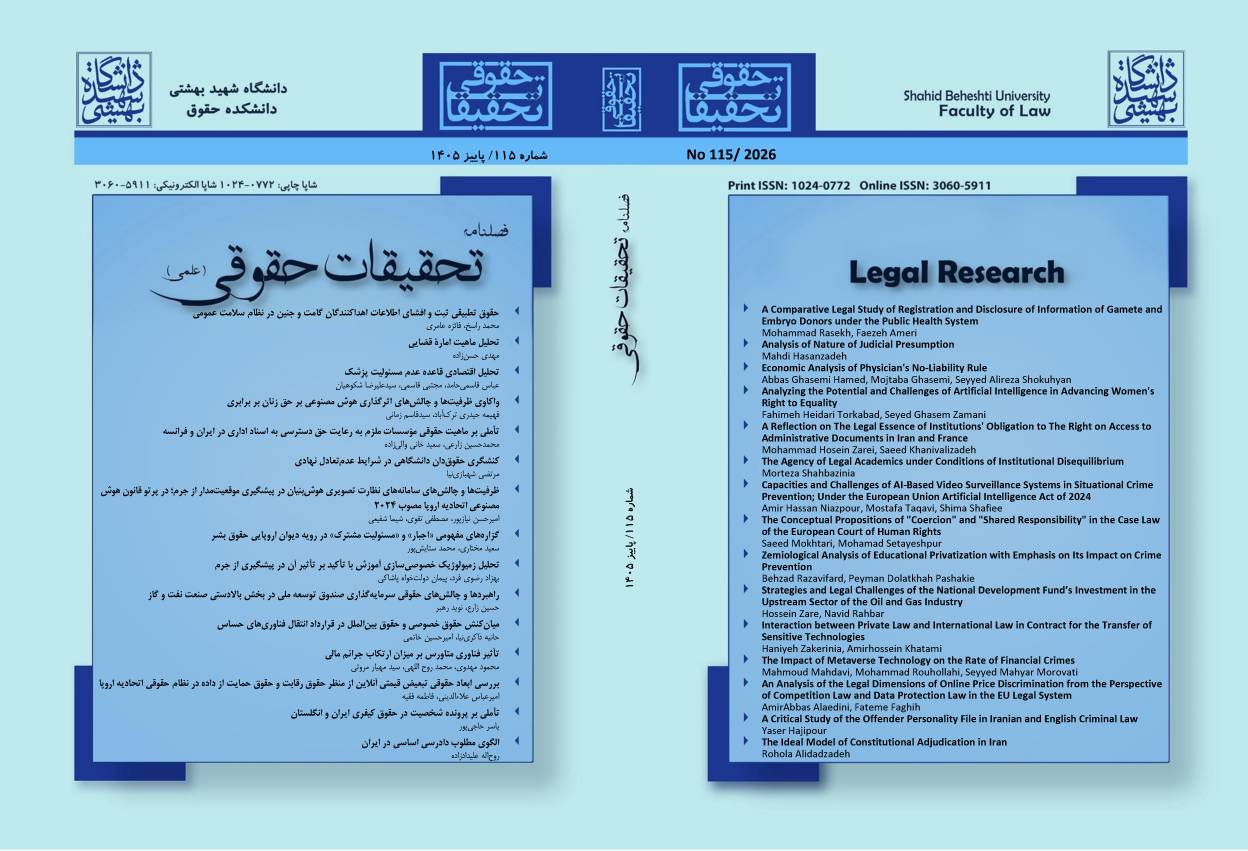
فصلنامه تحقیقات حقوقی

فصلنامه تحقیقات حقوقی

تحلیل زمیولوژیک خصوصی‌سازی آموزش با تأکید بر تأثیر آن در پیشگیری از جرم

نوع مقاله : مقاله پژوهشی

نویسندگان
1 دانشیار، دانشکده حقوق و علوم سیاسی، دانشگاه علامه طباطبایی، تهران، ایران
2 دانشجوی دکتری، دانشکده حقوق و علوم سیاسی، دانشگاه علامه طباطبایی، تهران، ایران (نویسنده مسئول) dolatkhah@atu.ac.ir
10.48308/jlr.2026.242977.3020
چکیده
چکیده
حق آموزش یکی از بنیادی‌ترین حقوق طبیعی و اجتماعی انسان است که تحقق عدالت اجتماعی، توسعه انسانی و برابری فرصت‌ها را تضمین می‌کند. بااین‌حال، گسترش سیاست‌های خصوصی‌سازی آموزش، این حق عمومی را به کالایی تجاری تبدیل کرده و دسترسی به آموزش را به قدرت خرید و موقعیت طبقاتی پیوند زده است. رویکرد زمیولوژیک امکان تحلیل پیامدهای گسترده و کمتر قابل مشاهده خصوصی‌سازی آموزش را فراهم می‌سازد. براین‌اساس، خصوصی‌سازی آموزش موجب ایجاد آسیب‌های ساختاری، ازجمله افزایش نابرابری اجتماعی و طبقاتی، محدودسازی دسترسی گروه‌های کم‌درآمد به آموزش باکیفیت، فشار اقتصادی و روانی بر خانواده‌ها و دانش‌آموزان، تضعیف سرمایه اجتماعی، کاهش انسجام مدرسه و بازتولید سلطه نولیبرالی می‌شود. این آسیب‌ها، از منظر پیشگیری از جرم، با افزایش عوامل خطر، کاهش مهارت‌های اجتماعی، محدودسازی فرصت‌های مشروع ارتقای اجتماعی و فرسایش کنترل اجتماعی، زمینه‌ساز رفتارهای انحرافی و خشونت می‌گردند. همچنین، خصوصی‌سازی آموزش به شکل‌گیری شبکه‌های سوداگرانه و الیگارشی آموزشی منجر می‌شود که با ایجاد نیازهای کاذب، دسترسی عادلانه به فرصت‌های آموزشی را محدود می‌کند. آثار منفی این سیاست‌ها بر معلمان شامل تضعیف دانشگاه فرهنگیان، به‌کارگیری نیروهای موقت و کاهش امنیت شغلی، نیز از منظر زمیولوژیک قابل تحلیل است. این مقاله با رویکرد توصیفی - تحلیلی و استفاده از منابع کتابخانه‌ای، ضمن بررسی چارچوب نظری و مفهومی زمیولوژی، آسیب‌های ناشی از خصوصی‌سازی آموزش و پیامدهای آن بر عدالت اجتماعی و پیشگیری از جرم را شناسایی، و بر ضرورت سیاست‌گذاری علمی و عدالت‌محور در حوزه آموزش تأکید می‌کند تا آموزش به‌عنوان حق عمومی و ابزار کاهش نابرابری و پیشگیری از آسیب‌های اجتماعی و جرم بازتعریف شود.

تازه های تحقیق

·         خصوصی‌سازی آموزش، در صورت غلبه منطق بازار و ضعف تنظیم‌گری عمومی، می‌تواند با افزایش وابستگی فرصت‌های آموزشی به قدرت اقتصادی، به بازتولید نابرابری اجتماعی و طبقاتی و ایجاد آسیب‌های ساختاری منجر شود.

·         آسیب‌های ناشی از نابرابری آموزشی، فشار اقتصادی و روانی، و تضعیف سرمایه اجتماعی می‌تواند ظرفیت پیشگیرانه آموزش را در زمینه جامعه‌پذیری، ایجاد فرصت‌های مشروع و کاهش عوامل خطر بزهکاری تضعیف کند.

·          تقویت آموزش عمومی، اجرای کامل اصل ۳۰ قانون اساسی، تنظیم‌گری مؤثر مدارس غیردولتی، حمایت پایدار از معلمان و افزایش پاسخ‌گویی نهادی از مهم‌ترین الزامات کاهش آسیب‌های ساختاری خصوصی‌سازی و حفظ کارکرد پیشگیرانه آموزش است.

کلیدواژه‌ها
موضوعات

عنوان مقاله English

Zemiological Analysis of Educational Privatization with Emphasis on Its Impact on Crime Prevention

نویسندگان English

Behzad Razavifard 1
Peyman Dolatkhah Pashakie 2
1 Associate Professor, Faculty of Law & Political Science, Allameh Tabataba'i University, Tehran, Iran.
2 PhD Candidate, Faculty of Law & Political Science, Allameh Tabataba'i University, Tehran, Iran. Corresponding Author Email: dolatkhah@atu.ac.ir
چکیده English

Abstract
Introduction
Education is one of the fundamental human and social rights and an important institutional basis for social justice, equality of opportunity, and human development. However, the expansion of educational privatization, particularly when accompanied by market-oriented and profit-seeking logic, may strengthen the relationship between access to education and household economic capacity and may generate consequences extending beyond educational administration. The central question of this article is how educational privatization may produce or intensify structural social harms and how such harms may weaken mechanisms of crime prevention. The article adopts a zemiological perspective, which does not confine the object of analysis to formally criminalized conduct but focuses on social harms, suffering, deprivation, inequality, and the structural effects of policies and power relations. The objective is to provide a zemiological analysis of the consequences of educational privatization and to explain its relationship with crime prevention. Education is therefore considered not merely a public service but also an institution that contributes to socialization, social capital, reduction of deprivation, and limitation of risk factors associated with offending.
Methods
The article employs a descriptive-analytical method and relies on documentary and library-based research. Persian and English sources concerning zemiology, educational privatization, the right to education, educational justice, crime prevention, social strain, and the social consequences of educational policies are examined. The analytical framework connects three components: educational privatization as a policy and institutional mechanism; zemiology as an approach to studying social harms generated by structures and policies; and crime prevention as one of the social functions of education. Accordingly, the article considers equal access, social and class inequality, economic and psychological pressure, social capital, educational relations, teachers’ employment conditions, and opportunities for social mobility, rather than economic or managerial indicators alone. The legal foundations of educational privatization in Iran and the position of Article 30 of the Constitution concerning public education are also considered. The analysis indicates an analytically relevant relationship between structural harms associated with educational policies and the preventive capacities of education, without claiming a definitive causal relationship between privatization and increased crime beyond the evidence and analytical framework of the sources examined.
Results and Discussions
The findings can be organized around several main dimensions. First, educational privatization may make access to quality education increasingly dependent on household purchasing power and economic position. Under such conditions, differences in family economic capacity can become differences in educational opportunity, and education may, in certain circumstances, reproduce rather than reduce existing social and class inequalities. From a zemiological perspective, some consequences may not constitute formally defined crimes while nevertheless appearing as deprivation, discrimination, economic pressure, and restricted opportunities for development and social mobility. Second, privatization may increase economic and psychological pressures on students and families. Educational competition, direct and indirect educational costs, and the growing importance of financial capacity in school and educational-service selection may, in the absence of compensatory mechanisms, create experiences of pressure and relative deprivation. Third, the article indicates that the commodification of education may contribute to the reproduction of relations of dominance and the concentration of educational opportunities among advantaged groups. The growth of educational and examination-preparation networks, and what the article describes as the “exam oligarchy,” is examined as a manifestation of concentration of educational resources and opportunities. Fourth, the consequences of privatization are not limited to students and families. Teachers’ conditions are also significant from a zemiological perspective. Temporary contracts, employment insecurity, economic pressure, and differences in employment conditions in non-governmental schools may constitute hidden costs of privatization. Fifth, the findings establish an analytical connection between educational privatization and crime prevention. Education has preventive capacity through socialization, development of social skills, legal awareness, legitimate opportunities for social mobility, and reinforcement of social capital. Factors that restrict equal access to these functions may reduce the preventive capacity of the educational system. Finally, the analysis emphasizes institutional responses and structural policy-making, including full implementation of Article 30 of the Constitution, strengthening public schools, effective regulation of non-governmental schools, limiting profit-oriented logic in basic education, greater transparency and accountability, sustained support for teachers, parental participation, and attention to critical education. The analysis also shows that the preventive role of education depends not only on enrollment but also on the quality, accessibility, continuity, and social inclusiveness of educational opportunities. Where educational resources become differentiated according to economic capacity, formally equal access may coexist with materially unequal opportunities. From the zemiological standpoint adopted in the article, such inequality is relevant because it distributes exposure to educational deprivation unevenly across social groups and may reinforce cumulative disadvantage. The discussion therefore treats educational privatization as a process whose social effects should be assessed together with the institutional arrangements that regulate fees, quality, admission, accountability, and protection of vulnerable groups. The article further emphasizes that crime prevention should not be reduced to direct interventions against offending; preventive capacity may also be strengthened through policies that reduce structural deprivation before it is translated into social exclusion or other risk conditions. From this perspective, educational privatization is not limited to financing arrangements or school administration; it also concerns the distribution of educational opportunities and their effects on different social groups. When access to quality education becomes excessively dependent on household financial capacity, economic differences may be transformed into differences in the quality and range of educational opportunities. This is significant from a zemiological perspective because social harm may be experienced before it appears as criminal conduct or an explicit violation of a criminal rule, in the form of deprivation, exclusion, pressure, perceived injustice, and reduced opportunities for social mobility. Accordingly, assessment of privatization should consider not only formal educational indicators but also its distributive and social consequences. The preventive role of education also requires attention to its indirect functions. Schools can provide settings for developing social skills, participation, learning social rules and norms, increasing awareness, and strengthening social bonds. Consequently, reduced equality of access to education or increased pressure resulting from competition and educational costs may affect the social and preventive capacities of the educational system. Within this framework, crime prevention is not limited to direct interventions designed to prevent offending; it also includes policies that reduce deprivation and strengthen legitimate opportunities, thereby creating more supportive social conditions. At the institutional level, the findings also emphasize the importance of public regulation. The participation of non-governmental actors in education, when not accompanied by clear rules, effective oversight, transparency, and mechanisms protecting vulnerable groups, may contribute to the intensification of some of the harms discussed in the article. The central issue is therefore not the absolute rejection of non-governmental participation in education, but the regulation of such participation in a manner that preserves the right to education, educational justice, and the social and preventive functions of schools. In this regard, strengthening public schools and providing sustained support for teachers, together with appropriate regulation of non-governmental schools, forms part of the structural response emphasized by the article.
Conclusion
The analysis indicates that educational privatization should not be assessed merely as the transfer of part of educational provision from the state to non-governmental actors. The manner in which privatization is regulated and implemented may affect the distribution of educational opportunities, social inequality, families and teachers, and consequently the preventive capacities of the educational system. A zemiological perspective makes these consequences visible as structural social harms. Accordingly, equitable educational policy and effective public regulation, together with the strengthening of public education, can contribute to reducing harms associated with educational inequality and preserving the long-term role of education in crime prevention

کلیدواژه‌ها English

Privatization
Education
Zemiology
Crime Prevention
Harm.
منابع
 کتاب‌
1.      امیدی، مسعود، کارنامه نئولیبرالیسم در ایران، تهران: گل‌آذین، 1402.
2.      زیباکلام، فاطمه، از مکتب تربیتی لیبرالیسم تا نئولیبرالیسم؛ نگاهی انتقادی، تهران: انتشارات دانشگاه تهران، 1402.
3.      ژیرو، هنری ا.ا.، درگیری نئولیبرالیسم با آموزش عالی، ترجمه انور محمدی، تهران: نشر تیسا، 1399.
4.      شیرازی، عظیم و محمد جعفری، برنامه خصوصی‌سازی کشور؛ عملکرد، ملاحظات و چالش‌ها، تهران: مؤسسه تحقیقاتی تدبیر اقتصاد، 1393.
5.      غلامی، حسین، درآمدی بر آسیب‌ اجتماعی‌شناسی (زمیولوژی)، تهران: پژوهشگاه علوم انتظامی و مطالعات اجتماعی ناجا، 1399.
6.      هاروی، دیوید، تاریخ مختصر نئولیبرالیسم، ترجمه محمود عبدالله‌زاده، تهران: نشر اختران، 1384.
 مقاله
7.      ایمان‌نمدیان‌پور، حیدر، علی‌اصغر جانعلی‌زاده و علی فیروزجائیان، «تأملی جامعه‌شناختی بر خصوصی‌سازی آموزش (مدارس غیردولتی) در ایران»، نشریه جامعه‌پژوهی فرهنگی، دوره 14، شماره 2، 1402، صص111-140. Doi: 10.30465/scs.2023.43806.2652
8.      جمالی، جلال و محمد سلطانی، «تأثیر خصوصی‌سازی مدارس و مدیریت آن بر کیفیت آموزش در ایران»، مجله جهان نوین، دوره 3، شماره 12، 1399، صص 35-47.
9.      حسنی، محمد، «نقدی بر سیاست خصوصی‌سازی تربیت مدرسه‌ای در نظام آموزشی ایران»، دوفصلنامه پژوهش‌نامه مبانی تعلیم و تربیت، دوره 13، شماره 2، 1402، صص 113-134.  Doi:  10.22067/fedu.2024.84268.1290
10. شاملو، باقر و غلامرضا اسماعیلی آذر، «الگوی سیاست جنایی در مواجهه با فساد سیاسی- اقتصادی نظام الیگارشی»، فصلنامه پژوهش‌های حقوق اقتصادی و تجاری، دوره 2، شماره 1، 1403، صص41-72. Doi: 10.48308/eclr.2024.234620.1050/
11. مرندی، الهه و اعظم قربانی، «مبانی و سازوکارهای حمایتی حق آموزش در قانون اساسی جمهوری اسلامی ایران و اسناد حقوق بشری»، فصلنامه مطالعات حقوق بشر اسلامی، دوره 10، شماره 1، 1400، صص91-120. Doi: 20.1001.1.23225637.1400.10.1.11.1/
گزارش‌
12. بیات، موسی و محمدرضا ملاشاهی، «بررسی روند ترک تحصیل و بازماندگی از تحصیل در آموزش و پرورش (سال‌های 1393 تا 1401)»، دفتر مطالعات فرهنگ و آموزش، مرکز پژوهش‌های مجلس شورای اسلامی، 1401.
References
Books
1.       Ball, S. J., & Junemann, C., Networks, New Governance and Education, 1st Ed. Policy Press, 2012.  Doi: 10.2307/j.ctt9qgnzt
2.       Canning, V., & Tombs, S., From Social Harm to Zemiology: A Critical Introduction, 1st Ed. Abingdon: Routledge, 2021.
3.       Dingerson, Leigh, Barbara Miner, Bob Peterson, and Stephanie Walters, eds. Keeping the Promise?: The Debate Over Charter Schools. Milwaukee, WI: Rethinking Schools, 2008.
4.       Gholami, Hossein, An Introduction to Social Harm Studies (Zemiology), Tehran: Research Institute of Law Enforcement Sciences and Social Studies, 2020. (in Persian)
5.       Giroux, Henry A. A., Neoliberalism’s War on Higher Education, Translated by: Anvar Mohammadi, Tehran: Tisa Publishing, 2020. (in Persian)
6.       Harvey, David, A Brief History of Neoliberalism, Translated by: Mahmoud Abdollahzadeh, Tehran: Akhtaran Publishing, 2005. (in Persian)
7.       Levin, H. M., Privatizing Education: Can the School Marketplace Deliver Freedom of Choice, Efficiency, Equity, and Social Cohesion, Boulder: Westview Press, 2019.
8.       Omidi, Masoud, The Record of Neoliberalism in Iran, Tehran: Golazin Publishing, 2023. (in Persian)
9.       Shirazi, Azim, and Mohammad Jafari, The National Privatization Program: Performance, Considerations, and Challenges, Tehran: Tadbir-e Eqtesad Research Institute, 2014. (in Persian)
10.    Verger, A., Lubienski, C., & Steiner-Khamsi, G., The Global Education Industry: World Yearbook of Education 2016, London: Routledge, 2016.
11.    Zibakalam, Fatemeh, From the Educational School of Liberalism to Neoliberalism: A Critical Perspective, Tehran: University of Tehran Press, 2023. (in Persian)
Articles
12.    Chen, Y.; Salagean, I.; Zou, B. “Private Educational Expenditure Inequality between Migrant and Urban Households in China’s Cities”. Economies ,Vol. 12, Issue 10, 2024, pp. 1-22. https://doi.org/10.3390/economies12100277 
13.    Hassani, Mohammad, “A Critique of the Policy of Privatizing School-Based Education in Iran’s Educational System”, Bi-Quarterly Journal of Research on the Fundamentals of Education, Vol. 13, Issue 2, 2023, pp. 113–134. Doi:  10.22067/fedu.2024.84268.1290/ (in Persian).
14.    Heissel, J. A., Adam, E. K., Doleac, J. L., Figlio, D. N., & Meer, J., “Testing, Stress, and Performance: How Students Respond Physiologically to High-Stakes Testing”, Education Finance and Policy, Vol. 16, Issue 2, 2021, PP 183–208. doi: 10.1162/edfp_a_00306.
15.    Hope, A., “The Shackled School Internet: Zemiological Solutions to the Problem of Over-Blocking”, Learning, Media and Technology, Vol. 38, Issue 3, 2013, PP 270–283. doi: 10.1080/17439884.2012.670646.
16.    Iman-Nemadianpour, Heydar, Ali-Asghar Janalizadeh, and Ali Firoozjaeian, “A Sociological Reflection on the Privatization of Education (Non-Governmental Schools) in Iran”, Cultural Sociology Studies Journal, Vol. 14, Issue 2, 2023, pp. 111–140. Doi: 10.30465/scs.2023.43806.2652/ (in Persian).
17.    Jamali, Jalal, and Mohammad Soltani, “The Impact of School Privatization and Its Management on the Quality of Education in Iran”, New World Journal, Volume 3, Issue 12, 2020, pp. 35–47. (in Persian).
18.    Koyama, A., et al., “Association between Depression, Examination-Related Stressors, and Sense of Coherence: The Ronin-Sei Study”, Psychiatry and Clinical Neurosciences, Vol. 68, Issue 6, 2014. PP 441–447. doi: 10.1111/pcn.12146.
19.    Lim, H. S., “The Impact of Korea’s ‘Hagwon’ Culture on Academic Pressure among High School Students”, Research and Advances in Education, Vol. 4, Issue 1, 2025. PP 1–10. doi: 10.56397/RAE.2025.01.01.
20.    Lochner, L., & Moretti, E., “The Effect of Education on Crime: Evidence from Prison Inmates, Arrests, and Self-Reports”, American Economic Review, Vol. 94, Issue 1, 2004, PP 155–189. doi: 10.1257/000282804322970751.
21.    Morandi, Elaheh, and Azam Ghorbani, “Foundations and Supportive Mechanisms of the Right to Education in the Constitution of the Islamic Republic of Iran and Human Rights Instruments”, Islamic Human Rights Studies Quarterly, Vol. 10, Issue 1, 2021, pp. 91–120. Doi: 20.1001.1.23225637.1400.10.1.11.1/ (in Persian)
22.    Rainford, Jon, “Using Zemiology to explore the potential social harms of a lifelong learning entitlement”, Journal of Education Policy, Vol. 41, Issue 5, 2026, pp. 1-20. doi: 10.1080/02680939.2025.2560376.
23.    Raymen, T., “The Enigma of Social Harm and the Barrier of Liberalism: Why Zemiology Needs a Theory of the Good”, Justice, Power and Resistance, Vol. 3, Issue 1, 2019. PP 134-163.
24.    Schmelkes del Valle, S., Robles Vásquez, H., & Santos del Real, A., “Education and Learning at the Bottom of the Pyramid”, in Learning, Marginalization, and Improving the Quality of Education in Low-Income Countries, Cham: Springer, 2020, pp. 223–276.
25.    Shamloo, Bagher, and Gholamreza Esmaeili Azar, “The Criminal Policy Model in Addressing Political-Economic Corruption in the Oligarchic System”, Economic and Commercial Legal Research Quarterly, Volume 2, Issue 1, 2024. pp.41-72. DOI: 10.48308/eclr.2024.234620.1050/ (in Persian)
Reports
26.    Bayat, Mousa, and Mohammad Reza Mollashahi, “An Analysis of School Dropout and Educational Exclusion in the Education System (2014–2022)”, Office of Culture and Education Studies, Research Center of the Islamic Consultative Assembly, 2022. (in Persian)
27.    UNESCO, Global Education Monitoring Report, Paris: UNESCO, 2018.
Websites
28.    donya-e-eqtesad.com/fa/tiny/news-3323680/

  • تاریخ دریافت 07 دی 1404
  • تاریخ بازنگری 10 بهمن 1404
  • تاریخ پذیرش 21 بهمن 1404